Nova: A personal companion robot for patients in the ward.
Introduction
Elderly care has become a thorny issue, especially in hospital wards where professional care workers
are in severe shortage. Patients spend long stretches of time without anyone to explain what's happening
to their body, help them follow rehab routines, or simply sit with them through a long night.
Nova is a small healthcare robot designed to live next to a patient's bed and
take on the parts of care that humans don't have the bandwidth for — bridging information gaps with
the medical team, supporting daily routines, and providing steady emotional company so life in the
ward is no longer depressing. The project brought together industrial design, interaction design, and
embedded prototyping to ask what it actually takes for a robot to feel like a presence rather than a
piece of equipment.
Project Type
Team Project — Industrial Design × Interaction Design
Research Methods
Field work
Interview
Contextual Inquiry
Persona
User Journey Map
Usability Testing
Why hospital wards are uniquely hard to live in — and how care gaps form.
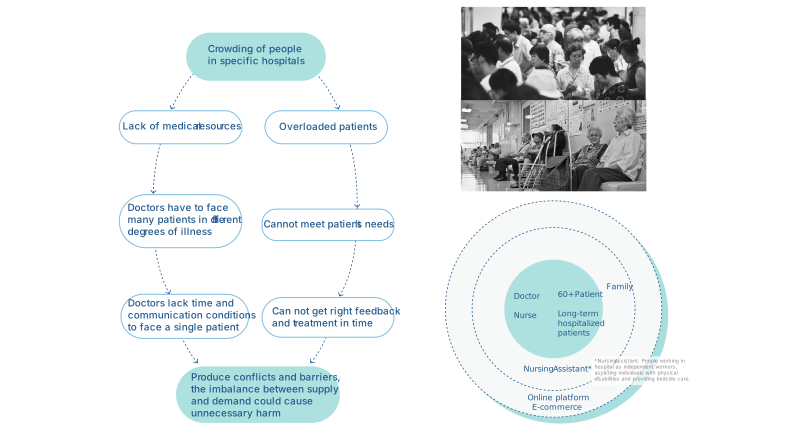
In China, hospital service is not stratified — everyone tends to choose large, guaranteed public
hospitals for treatment, which leaves the system severely overcrowded. Medical resources are limited
and the medical level is uneven across institutions, so patients' difficulties often can't be
effectively solved within a single visit.
Mapping the system this way made clear that the problem isn't only clinical. The same overcrowding
that strains doctors also strains the human relationships around a patient: nurses run between rooms,
family members can't always stay overnight, and information about what's happening to a body has to
pass through too many hands to arrive intact.
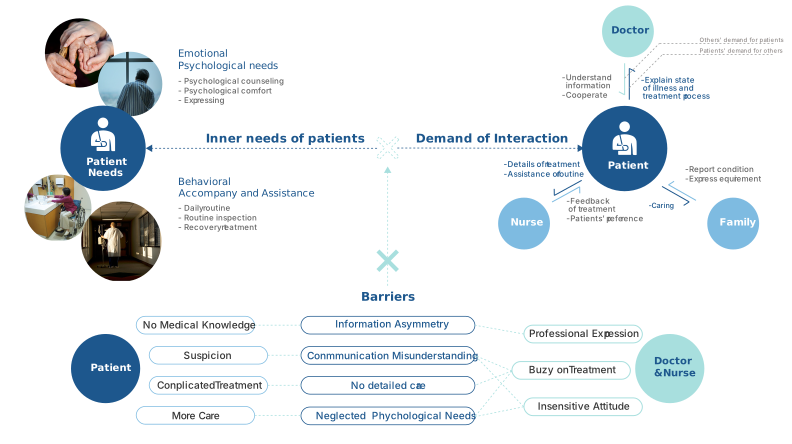
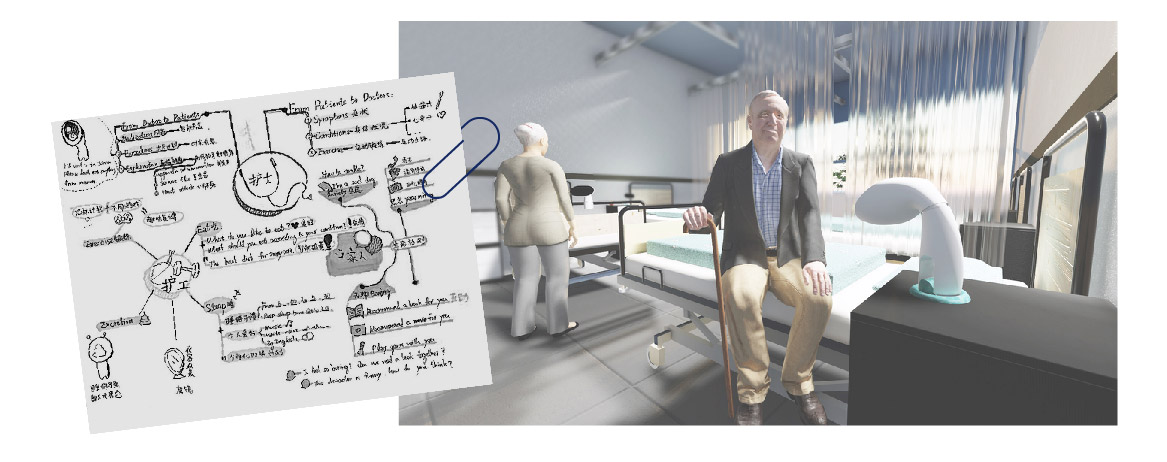
We then mapped the gap directly — what each role (patient, nurse, family) needs to give and receive, and
where those exchanges break down. The result wasn't a list of missing services; it was a picture of three
people in the same room who couldn't quite reach each other.
Primary Research
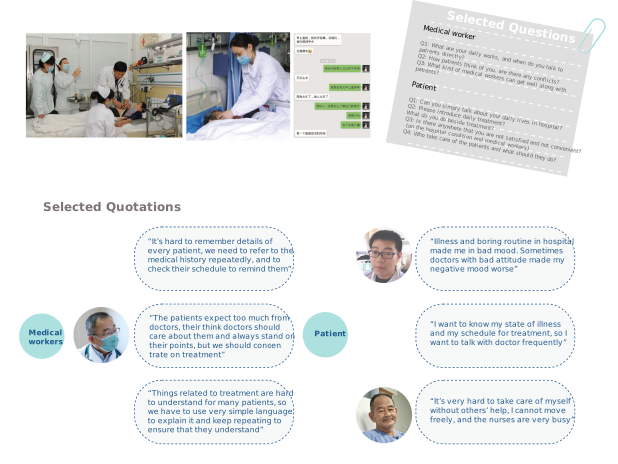
Listening to patients, nurses, and family inside Xinhua Hospital.
We spent time at Xinhua Hospital observing the general environment and the living conditions of patients,
then ran 15 in-depth conversations across the three roles that share a ward room: patients,
nurses, and family members. We watched routine check-ins, doctor visits, mealtimes, and the long quiet
stretches in between.
Patients spoke about the helplessness of not understanding their own diagnosis, the boredom of being
bedridden for days, and the loneliness that creeps in after visiting hours end. Nurses described being
stretched too thin to explain anything beyond the basics. Family members carried the emotional weight but
often couldn't be present when it mattered most. What surfaced wasn't a clinical problem — it was a
communication and presence problem hiding inside a clinical one.
Analysis
Basic needs and emotional needs both depend on others — and that's where care breaks down.
Sorting the interview notes, we landed on a simple framework: patients have basic needs
(medication, mobility, hygiene, monitoring) and emotional needs (understanding, company,
reassurance, distraction). Almost every need on both lists is relational — it requires another person to
be in the room, paying attention, at the right moment.
That dependency is exactly where care breaks down. Limited staffing means nurses can't be present for
every emotional moment; family can't be present for every clinical one; and no current tool covers the gap
between them. The design opportunity isn't to replace nurses or family — it's to take on the small,
always-on moments of presence that neither can.
Synthesis
Designing for the patient who is alone, tired, and waiting.
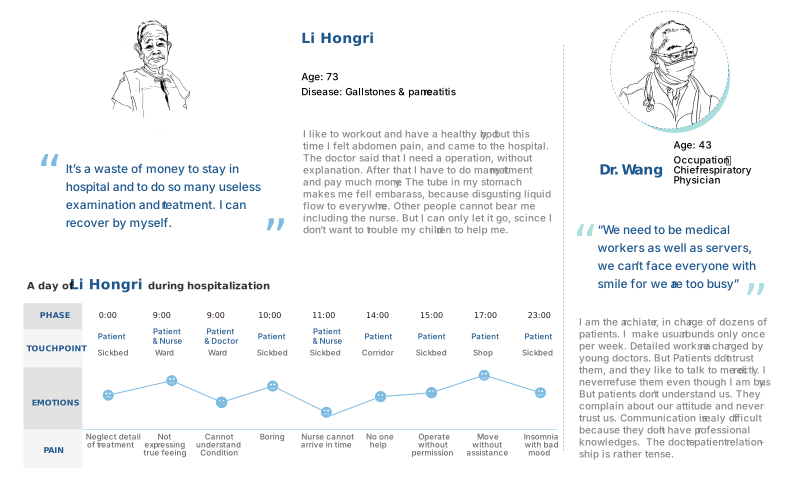
We translated the research into a primary persona and a single problem statement to keep the team aligned.
The persona isn't the average patient — it's the moment when even the average patient is hardest to reach:
mid-stay, somewhat stable medically, but emotionally untethered. The problem statement names the gap our
design has to fill without overreaching into clinical territory.
Persona
Problem Statement
The Robot
A presence that's always there — bridging information, care, and emotion.
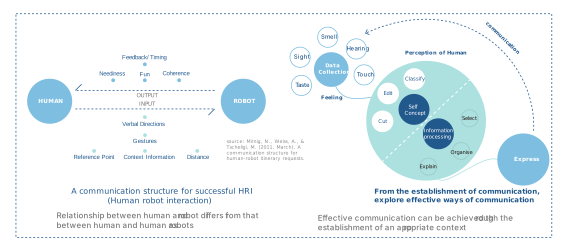
Once we framed the problem as "presence and communication," a robot stopped looking like an obvious answer
and started looking like the right one. Three properties of a robot map directly onto the gaps we mapped
earlier — and none of the alternatives we considered (an app, a wearable, a smart speaker) cover all three.
Connected to online data — so it can bridge the information gap between patient and
doctor, translating clinical language and surfacing what the patient needs to know.
Always online — so it can offer care in the moments when neither nurse nor family is
in the room, without the patient having to ask.
Natural interaction with humans — so it can support emotional function, not just
utility. A presence that responds, not a device that beeps.
Form Development
Shaping a body that feels approachable while housing every needed component.
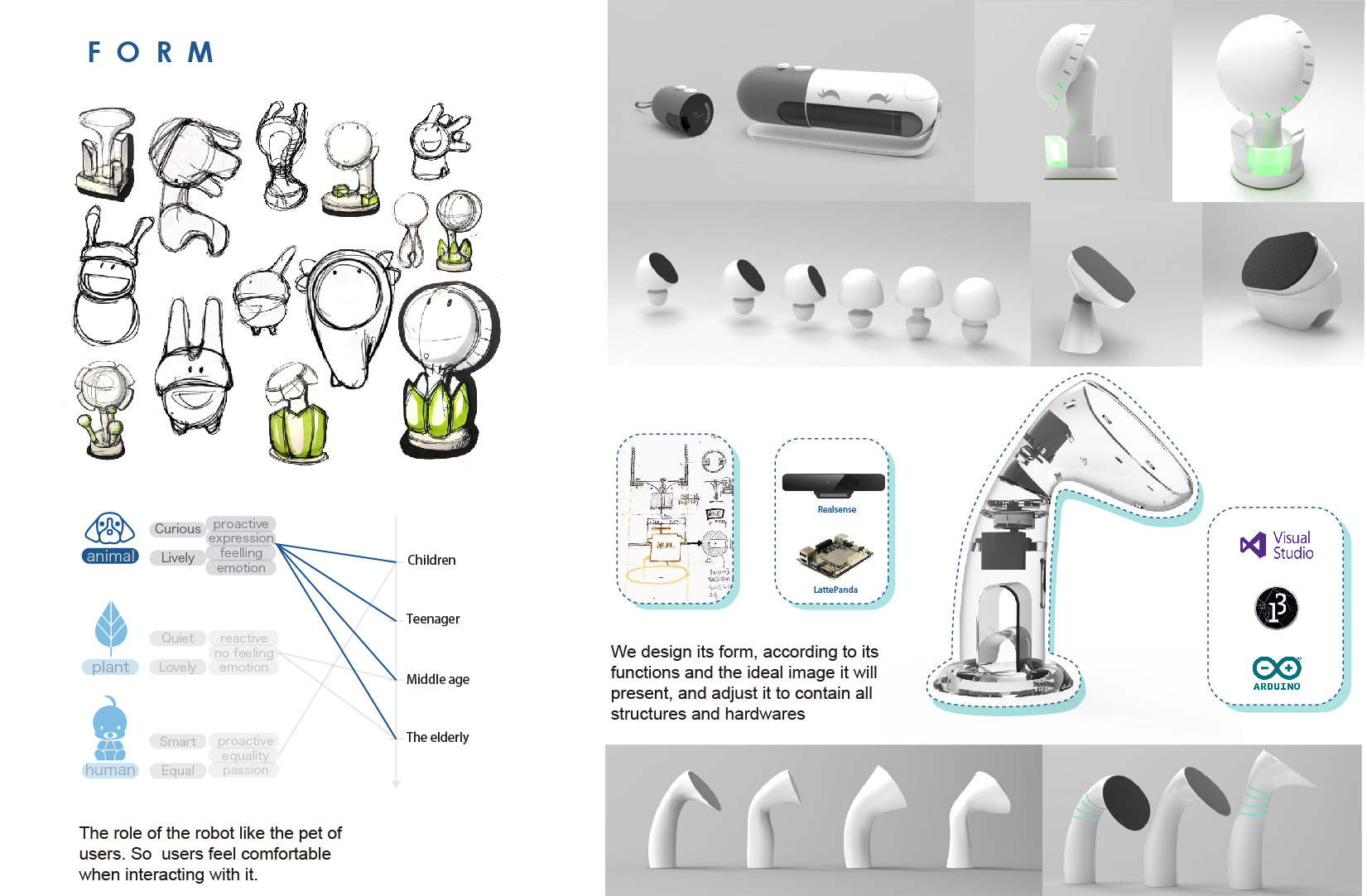
The form had to do two jobs at once: house the working hardware (depth camera, screen, speakers, processing,
battery) and convey the kind of presence we wanted patients to feel when they woke up next to it. We
iterated through rounded, anthropomorphic, and animal-inspired silhouettes before landing on a soft,
shoulder-height body with a tilted "face" that reads as attentive without being uncanny.
The proportions were tuned for a bedside table — small enough not to dominate the room, tall enough that a
patient lying down doesn't have to twist to see the screen. Every iteration was 3D-printed and placed next
to an actual hospital bed to gut-check scale and presence before committing to the next version.
Final Works
Meet Nova — nurse, caregiver, and quiet companion in one.
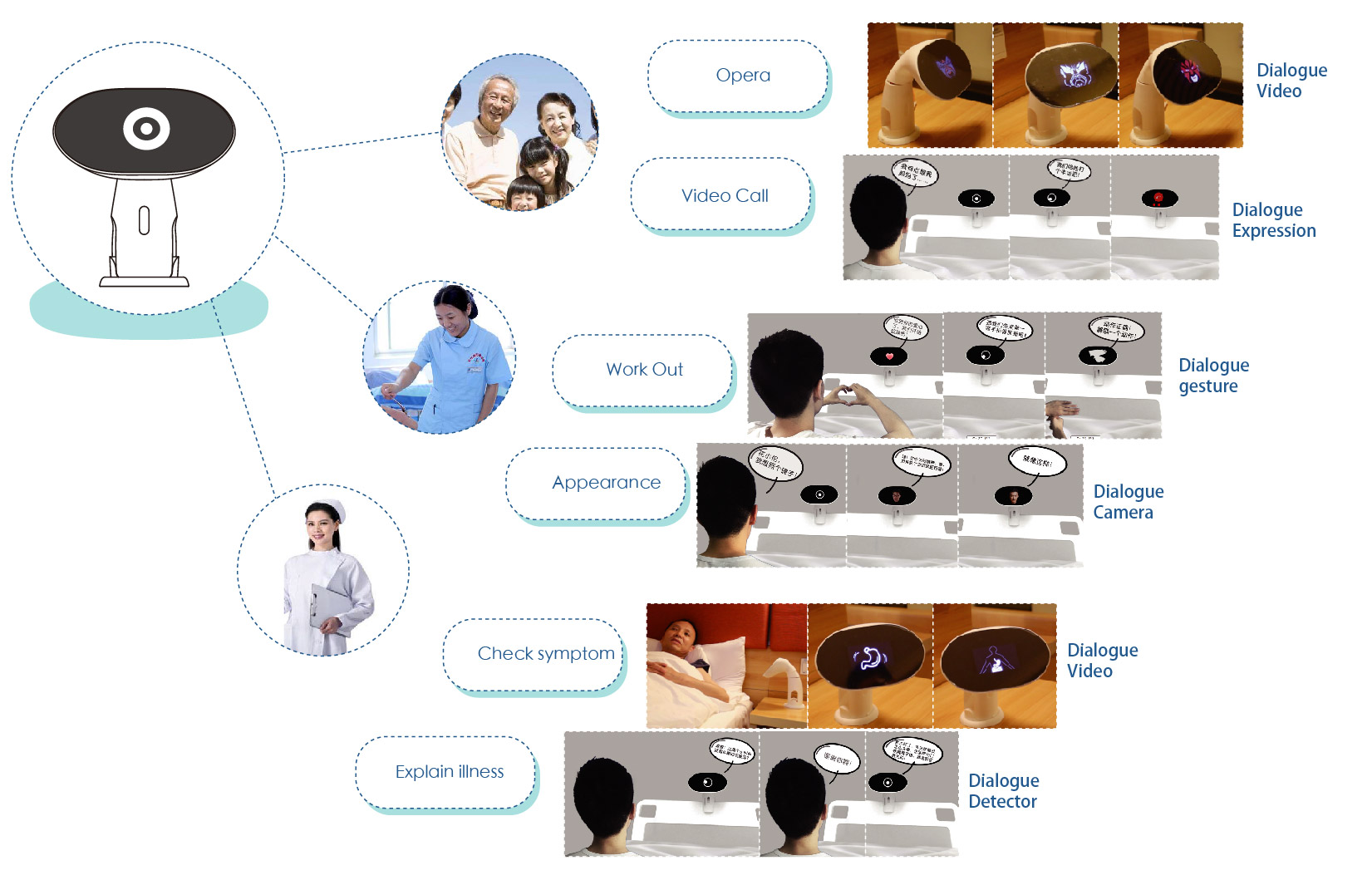
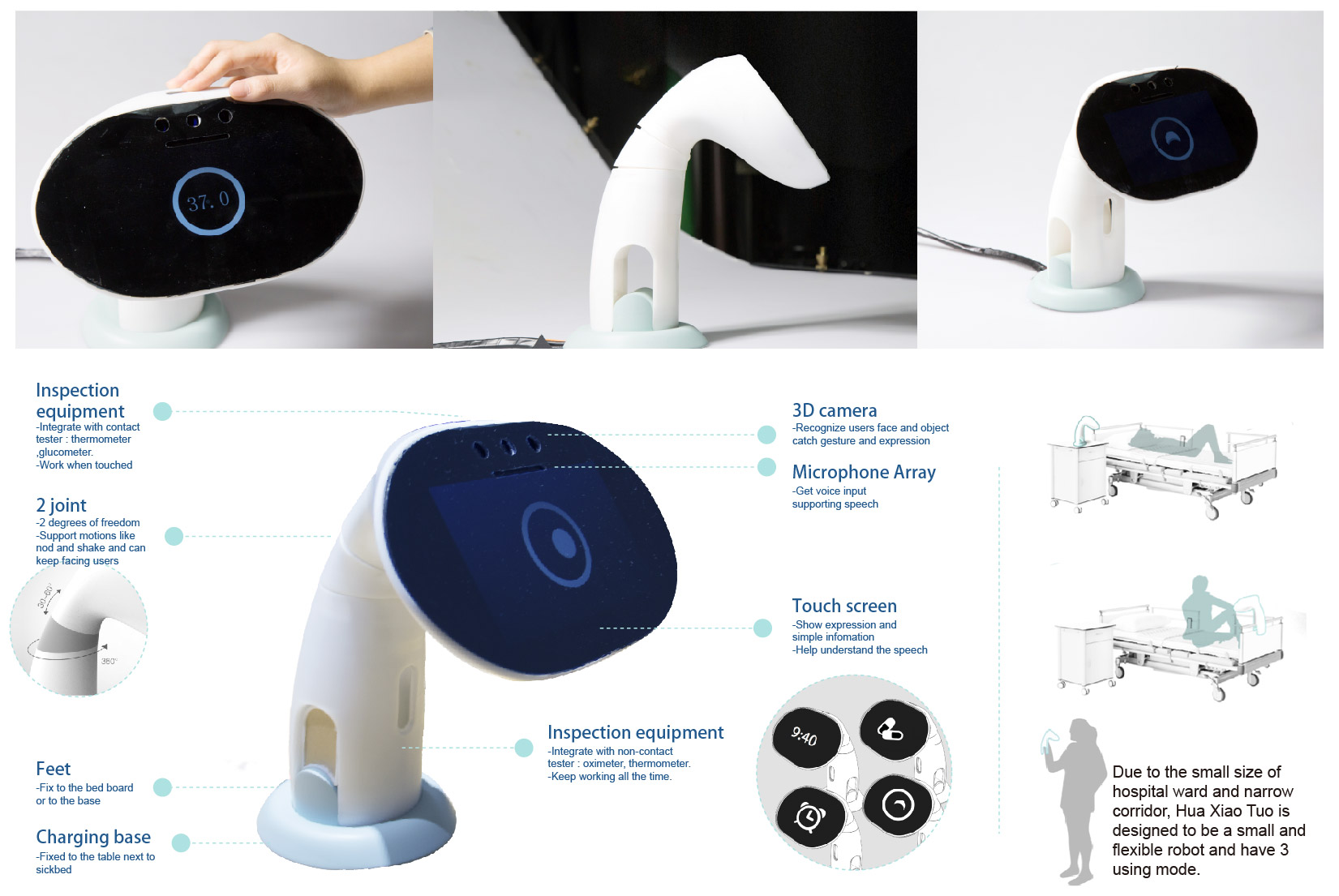
Nova is a small healthcare robot built to live in the ward alongside the patient. She moves between
three roles depending on what the moment asks for — nurse, caregiver, and family member — handling
information communication, daily care, and emotional support without the patient needing to explicitly
switch modes.
She can run routine health examinations and patiently explain what they mean in plain language. She can
translate a doctor's instructions into a follow-along rehab session. She can notice when a patient has been
awake for too long and offer something calming. The clinical work matters, but the larger point of the
design is the more ordinary one — to make life in the ward no longer boring, no longer silent, no longer
a place a patient has to face alone.
Industrial Design
From sketch to physical form.
The industrial design carries the warmth of the interaction. Soft matte surfaces avoid the cold reflectivity
of clinical equipment; rounded corners and a slight forward lean make the body read as friendly rather than
mechanical. The screen sits at face height when the robot is on a bedside table, so eye contact feels natural
rather than top-down or bottom-up.
Internally, the body is organized around the sensor stack — Intel RealSense for depth perception, a small
display for face and content, speakers tuned for speech intelligibility, and the compute to drive natural
interaction. The shell was developed in Rhino, rendered in Keyshot, and brought into the physical world with
3D printing for tactile review at full scale.
Interaction Design
A day with Nova — five moments where presence matters.
Rather than designing a flat feature list, we wrote scenarios anchored to specific times of day — the
moments when our research showed care most often broke down. Each scenario is small on its own, but
together they cover the rhythm of a real ward day from quiet morning to long, sleepless night.
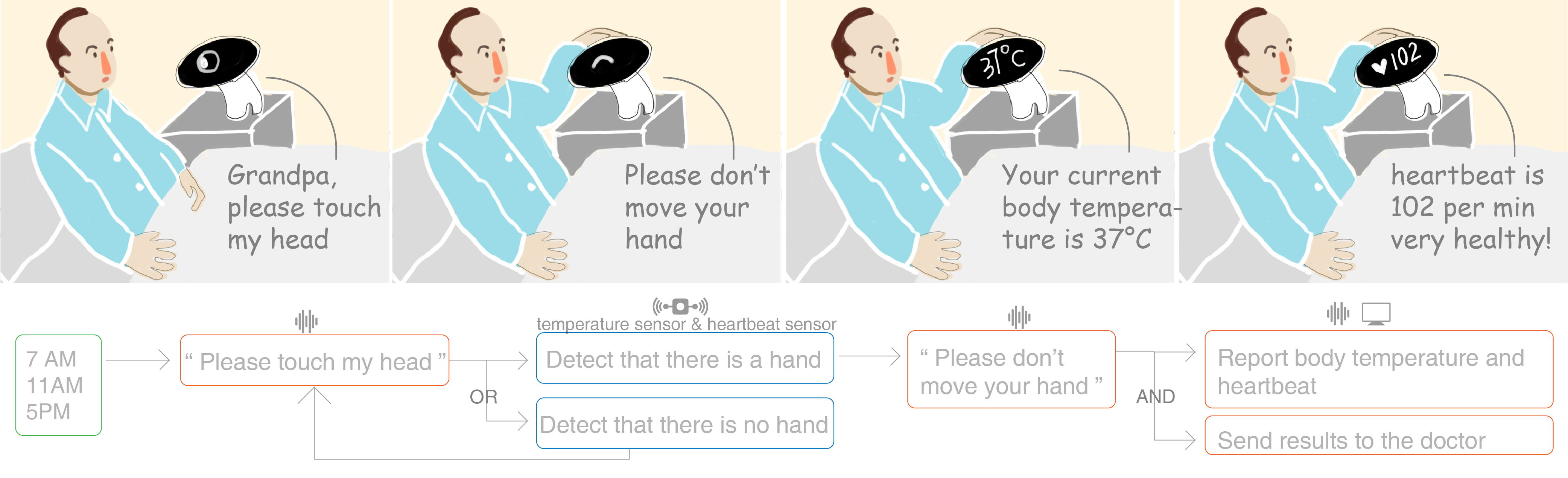
8:00 — Routine check, when the patient doesn't want to be disturbed by nurses
Early morning vitals are necessary but disruptive. Nova runs the check passively — temperature,
heart rate, simple visual cues — without forcing the patient awake. Results sync back to the nurse's
station so the human team stays informed without interrupting rest.
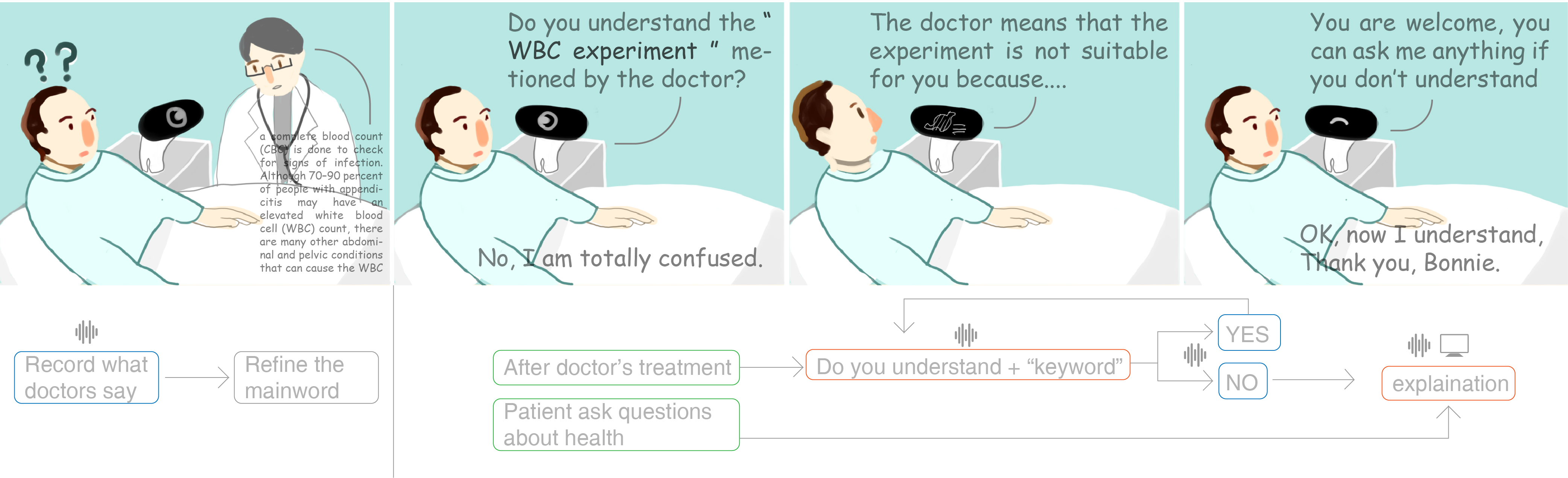
9:00 — Explaining the doctor's words after treatment
Doctors round quickly and speak in clinical shorthand. Patients often nod without understanding, then sit
with worry afterward. Nova replays the visit in plain language, answers follow-up questions, and
keeps the doctor's actual instructions visible so nothing is lost between rounds.
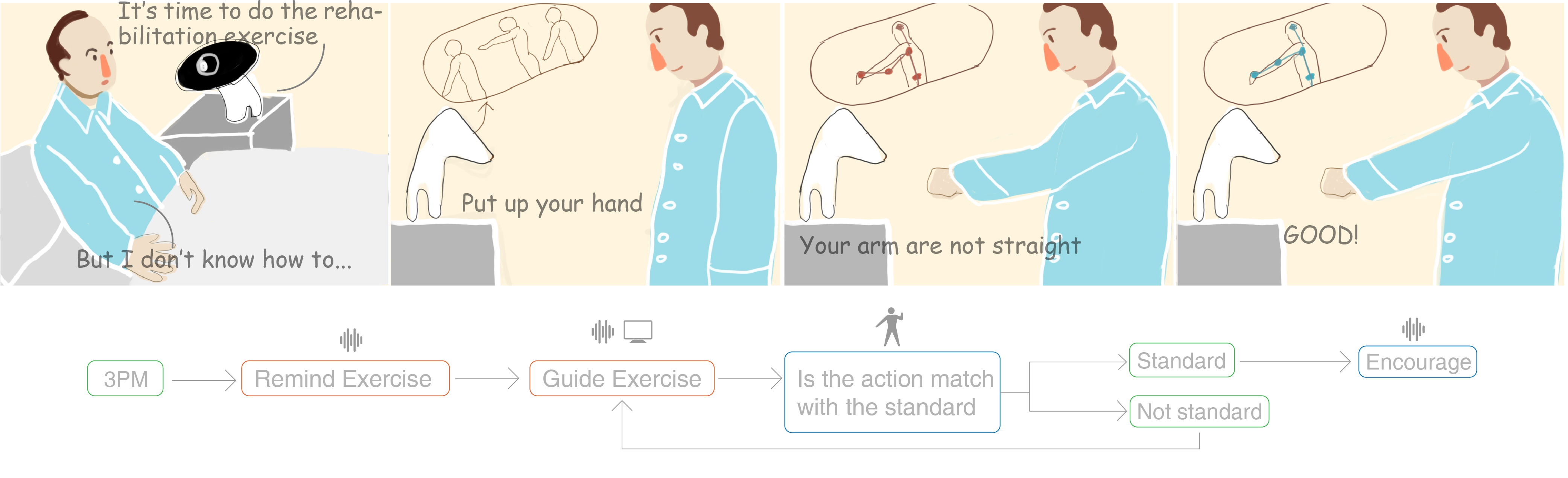
13:00 — Guiding rehabilitation when the patient doesn't know how
Rehab exercises are easy to demonstrate once and hard to remember alone. Nova demonstrates each
movement, paces the patient through it, and uses the depth camera to give gentle feedback when posture
drifts — turning a static printout into an active, patient session.
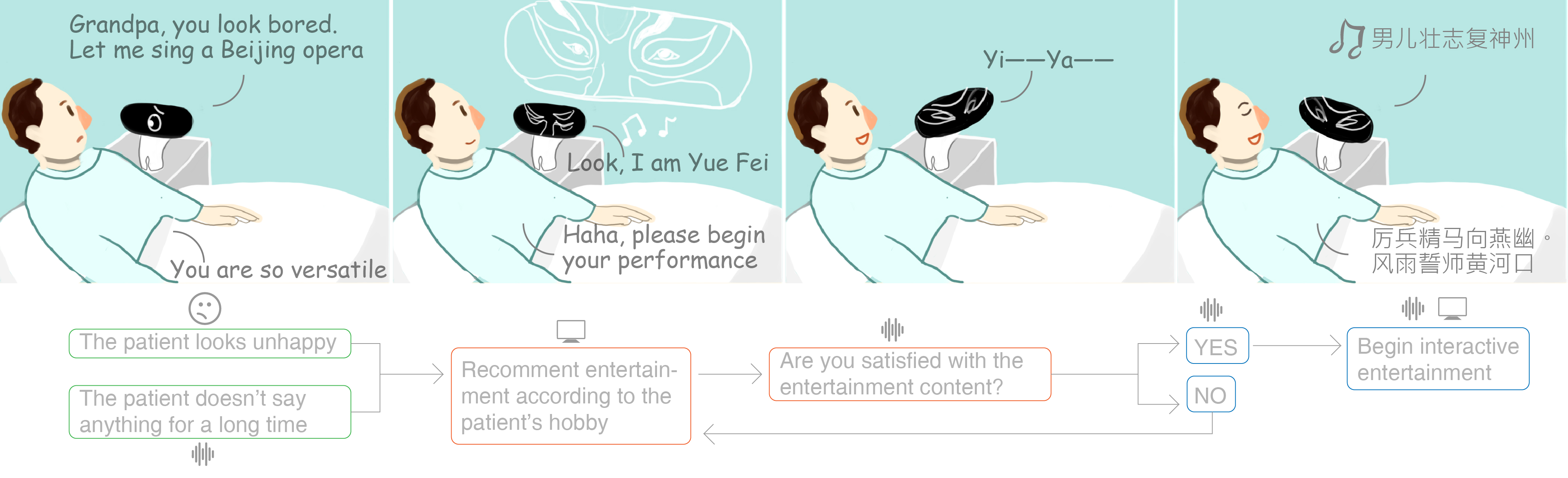
14:00 — Interactive entertainment when the patient doesn't know what to do
Long afternoons in bed are some of the hardest. Nova suggests low-effort activities — light games,
memory exercises, music, a video call to family — calibrated to how the patient is feeling that day, so
the choice doesn't itself become a burden.
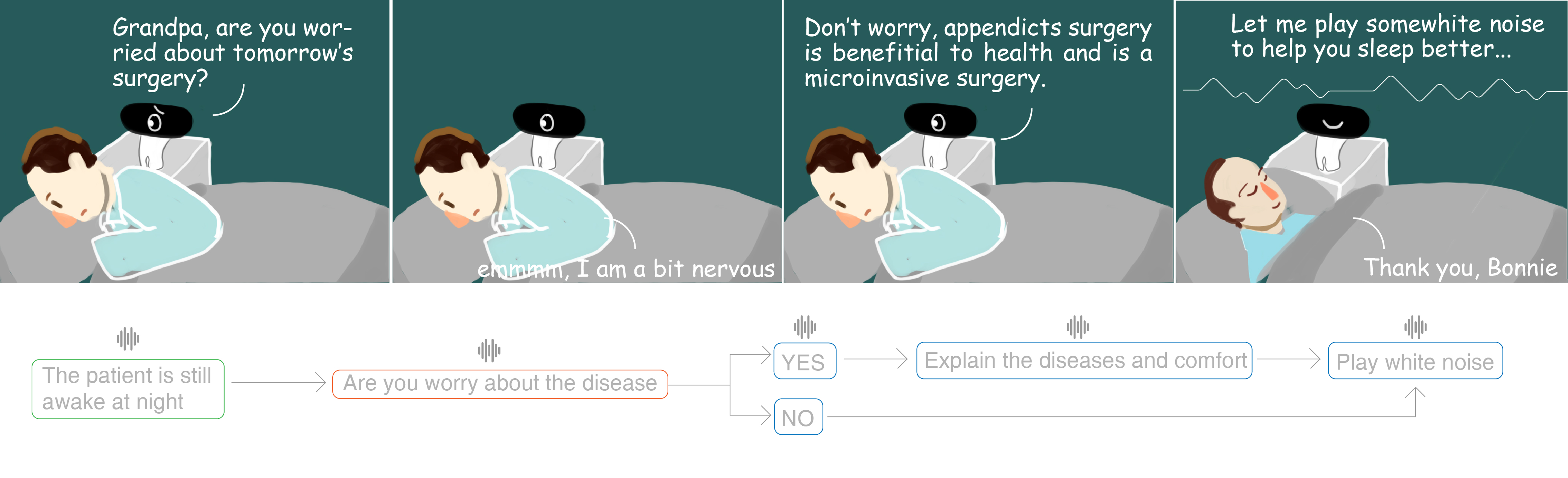
23:00 — Emotional comfort when the patient is sleepless
Late nights amplify worry. When the patient is awake long past lights-out, Nova lowers her voice
and the screen warmth, offers to read or play something quiet, or simply sits in soft standby — present
without performing. It's the most basic feature on the list, and the one patients told us they wished
most for.
Journey Map
One day, mapped end to end.
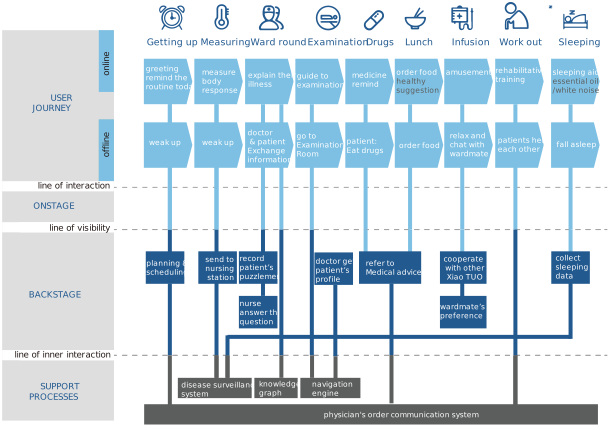
Stitching the five scenarios together with the spaces between them produced the full-day journey map.
Reading it left-to-right shows where the patient's emotional state dips, where the robot steps in, and
where the human team picks back up — making it easier to defend design decisions against "couldn't this
just be a nurse?" by showing exactly which moments a nurse never reaches.
Demo
See Nova in motion.
The working prototype was built with Intel RealSense for depth sensing, Arduino for motion control, and a
Visual Studio app driving the screen and voice. The video below walks through a condensed version of the
day — the morning check, the doctor-translation moment, and the late-night standby — using the 3D-printed
body and live hardware.